
Table of Contents
- 1. Understanding the g/m² in professional textiles: Beyond the simple weight
- 2. In-depth analysis: 450 g/m² sponge
- 3. The excellence of 600 g/m²: Synonymous with luxury and longer duration
- 4. Key factors in the choice: A strategic approach for your business
- 5. Why choose ZA&BEL professional sponges…
- 6. Frequently Asked Questions (FAQ)
1. Understanding the g/m² in professional textiles: Beyond the simple weight
The grams per square meter (g / m²) is the standard unit of measurement used to indicate the weight and density of a fabric, in this specific case, of the cotton sponge. A higher g/m² value does not inherently mean “better” in any context, but indicates a greater amount of fiber per unit of surface. This translates into specific characteristics that directly affect the performance and perception of the product.
For B2B operators in the hospitality and wellness sector, g/m² is a key parameter that affects several aspects:
- Absorbing capacity: Generally, a higher weight corresponds to an increased ability to absorb liquids, thanks to the greater quantity of sponge rings.
- Softness and feel: Higher g/m² towels tend to be softer and fuller to the touch, offering a feel of luxury and superior comfort.
- Durability and resistance: Dense fabrics are usually more resistant to wear, frequent washing and aggressive action of chemicals used in industrial laundries.
- Drying time: Heavier towels take longer to dry, a critical factor for washing cycles and energy consumption.
- Cost: Of course, a greater amount of raw material and a denser texture imply a higher unit cost.
Understanding these attributes is the starting point for an informed choice, which balances customer satisfaction with operational efficiency and investment sustainability.
2. In-depth analysis: 450 g/m² sponge
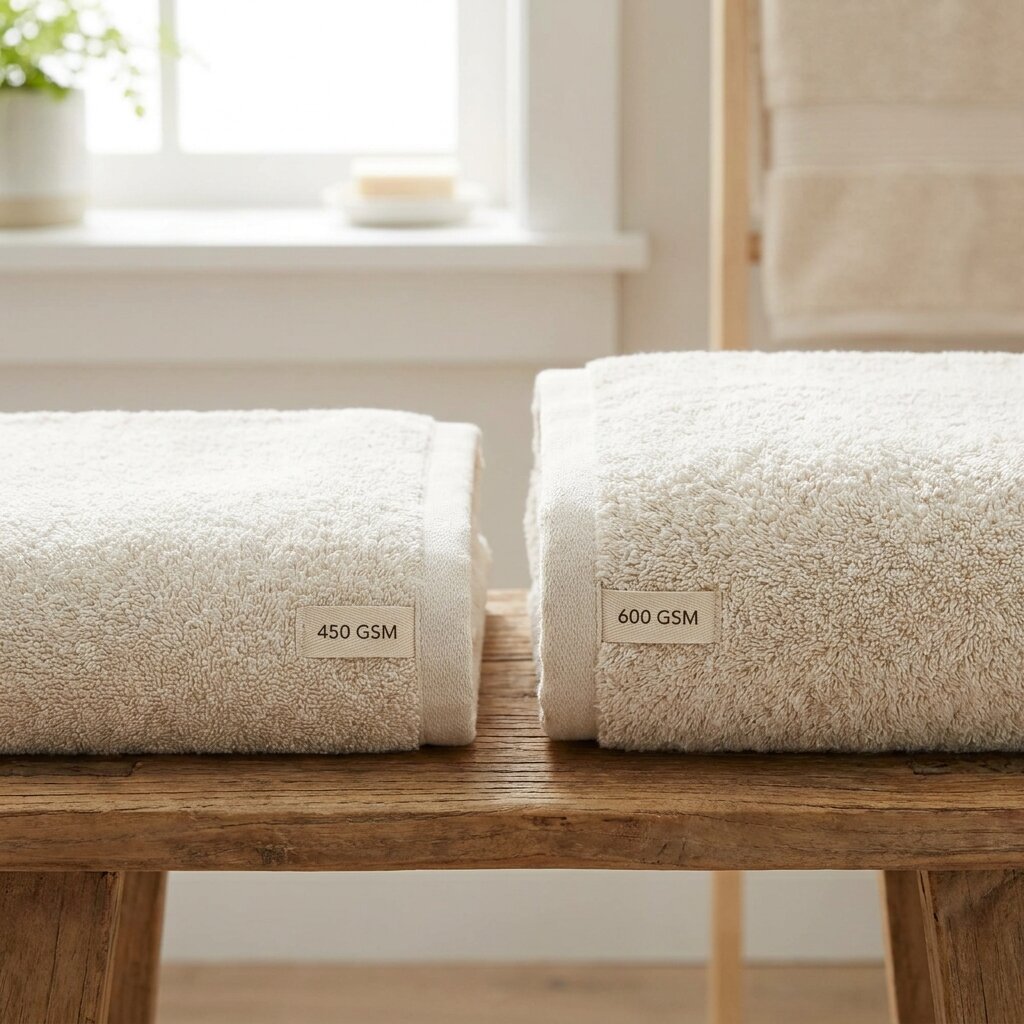
The sponge with a weight of 450 g / m² is positioned as a balanced solution, particularly appreciated in contexts where practicality and efficiency must be combined with a good perceived quality. This type of towel is not to be considered a “second choice” option, but rather a strategic resource for specific operational needs.
2.1 Advantages of the sponge 450 g/m²:
- Quick drying: Being less dense, the 450 g/m² sponge dries much faster. This translates into reduced processing times in laundries and lower energy consumption, both for drying and for any re-stretches. for structures with high spare volumes, such as the areas dedicated to swimming pools and spas With frequent customer rotation, this is a significant advantage.
- Lightness and handling: The lower weight makes these towels easier to handle, both for the service staff and for transport and storage.
- Low cost: The lower use of raw materials is reflected in a more accessible purchase cost, allowing you to manage more stringent budgets or offer an optimal quality-price ratio.
- Versatility: It adapts well to different situations, from standard hotel rooms to fitness centers, where the towel is a high-rotation consumption commodity.
2.2 Limitations and considerations for the 450 g/m²:
- Tactile Feeling: Although comfortable, the 450 g/m² sponge does not offer the same feel of fullness and luxury as superior weights. Its softness is good, but it does not “cuddle” in the same way.
- Duration over time: While being robust if of high quality, a 450 g/m² sponge could show signs of wear faster than a heavier equivalent in highly intensive industrial washing settings.
- Absorbing capacity: The absorption capacity is good, but lower than that of a denser sponge, which may require the use of multiple towels for complete drying in certain situations.
In summary, the 450 g / m² sponge is ideal for those looking for a balance between functionality, costs and a good user experience, especially where replacement is fast and logistics is a key factor.
3. The excellence of 600 g/m²: Synonymous with luxury and longer duration
When the goal is to offer an uncompromising luxury experience, the 600 g / m² sponge emerges as the favorite choice. This weight represents the top of the offer for professional bath linen, raising the perception of quality and care to the highest level.
3.1 Advantages of the sponge 600 g/m²:
- Unsurpassed softness and comfort: The superior density of the fabric, with a greater quantity of cotton rings, gives the 600 g / m² sponge an exceptional softness and a feeling of voluminousness and luxury to the touch, pampering the host in an unparalleled way.
- Maximum absorbing capacity: Thanks to its consistency, this weight guarantees rapid and efficient absorption, drying the body with a few gestures and offering a complete well-being experience.
- Extreme Durability: The greater amount of fiber per square meter makes the 600 g/m² sponge inherently stronger and more durable. It is designed to withstand intensive industrial washing cycles, maintaining its softness and integrity characteristics for a significantly longer period of time. This results in a longer lasting investment and a lower long-term replacement cost, a crucial aspect for industrial laundries which handle large volumes.
- Prestige image: The use of 600 g / m² hand towels immediately communicates a message of attention to detail and high service standards, strengthening the image of a luxury brand.
3.2 Limitations and considerations for the 600 g/m²:
- Longer drying times: High weight and density result in longer drying times, with a consequent increase in energy consumption during the laundry.
- Higher initial cost: The initial investment for the purchase of 600 g / m² sponges is higher, but must be evaluated with a view to durability and perceived value over time.
- Weight and size: Heavier towels are also bulkier, which can affect the storage and internal logistics of the facility.
The 600 g/m² sponge is the choice of choice for 5-star hotels, luxury resorts, boutique hotels, exclusive suites and high-end spas, where customer experience is a priority and every element must contribute to an atmosphere of refined opulence.
4. Key factors in the choice: A strategic approach for your business
The decision between a 450 g/m² and a 600 g/m² weight should not be taken lightly, but based on an in-depth analysis of the specific operational needs and positioning of your brand. Here are the key factors to consider:
4.1 Your target of customers
- Luxury & Premium: If your facility is aimed at a demanding audience looking for an experience of the highest level (5-star hotel, luxury spa, prestigious yacht), the 600 g / m² is almost an essential requirement. The feeling of softness and opulence to the touch significantly contributes to the perception of the value and the service offered.
- High standard and comfort: For 3-4 star hotels, quality B&Bs, or environments where comfort is important but efficiency is a priority, the 450 g / m² can be an excellent solution that offers a good balance between quality and cost management.
4.2 Frequency and type of use
- Daily use and high spare parts: In contexts such as swimming pools, gyms, high-affluence wellness areas or rooms with high rotation, the 450 g / m² sponge, thanks to its speed of drying and lightness, can be more efficient in terms of management and laundry costs.
- Exclusive and less frequent use: In suites, spa cabins for special treatments or in environments where the towel is a key element of the relaxing experience, the 600 g / m² sponge guarantees that cuddle and that sense of exclusivity that justify the greatest investment.
4.3 Operational costs and sustainability
- Laundry energy consumption: 600 g/m² towels, being thicker and more absorbent, will require more time and energy to dry completely. If your facility manages the laundry internally or relies on an external partner who invoices by weight or cycles, this is a cost to consider. The 450 g/m² sponge can offer an advantage here.
- Duration and replacement rate: Although the initial cost of 600 g/m² is higher, its inherent wear and tear resistance can extend its useful life, reducing the replacement frequency and, consequently, the total cost of ownership in the long run. It is an investment that pays off over time.
- Environmental Impact: The increased durability of a superior quality fabric, such as 600 g/m², can contribute to a lower ecological footprint, reducing the need to frequently produce and dispose of new linen.
4.4 Customization and brand image
Regardless of the weight chosen, the ability to customize the linen with the logo or colors of your brand is an added value that strengthens the visual identity and memorability of the experience offered. A high quality sponge, whether 450 or 600 g / m², becomes a powerful marketing vehicle if treated in detail.
Why Choose ZA&BEL Professional Sponges for Your Business
The choice of the right g / m² is just the beginning. To ensure that the investment translates into an experience of excellence and unparalleled durability, it is essential to rely on a trusted partner like ZA&BEL. Since 1969, our Made in Italy production in Busto Arsizio has been synonymous with craftsmanship and textile innovation. We select only the finest long-fiber and double twist yarns, elements that give our sponges an unparalleled strength and softness. Each item is designed to offer total dimensional stability and certified resistance to intensive industrial washing cycles, maintaining its value over time. In addition to the intrinsic quality of the product, ZA&BEL stands out for its tailoring customization, allowing you to create linen that reflects the unique identity of your brand, and for punctual and reliable logistics, essential for the efficient management of professional supplies.
The choice of the perfect grammar for your hotel, spa or spa center linen is a strategic investment that defines the comfort and luxury perception of your guests. Do not leave the sensation on the skin, the absorbent capacity or the resistance to intensive washing to chance. Each fiber counts in building an impeccable experience that elevates your standard of hospitality.
Rely on the experience and Made in Italy quality of ZA&BEL to find the ideal textile solution. Whether you are oriented towards the practicality of 450 g / m² or the opulence of 600 g / m², our experts are ready to guide you in selection and customization for your structure.
Request a sample and consultancy