
Table of contents
1. Spa bathrobes and the guest experience
A professional spa bathrobe combines guest comfort, presentation and practical handling. It is worn between treatments, after showers and in relaxation areas, making softness, fit and absorbency important selection criteria.
A soft, absorbent bathrobe contributes to comfort after a pool visit, sauna or treatment. Coordinated textiles reinforce the spa's visual identity.
1.1 Comfort and functionality in spas
Besides softness, the functionality of a professional spa bathrobe depends on:
- Optimal Absorbency: The ability to effectively dry the skin is critical to post-treatment or post-pool comfort. Highly absorbent materials reduce waiting time and improve the guest experience.
- Quick drying: For busy spas, lighter constructions can reduce drying time and help manage laundry turnover.
- Lightness and freedom of movement: Choose the fit and weight for comfortable movement between treatments, pools and relaxation areas.
- Resistance to external agents: Chlorine, essential oils, salts and creams can affect textile appearance and service life. For our own coloured production, we use Indanthrene dyes selected for colourfastness to chlorine, light and frequent washing.
2. Spa bathrobe fabrics and GSM
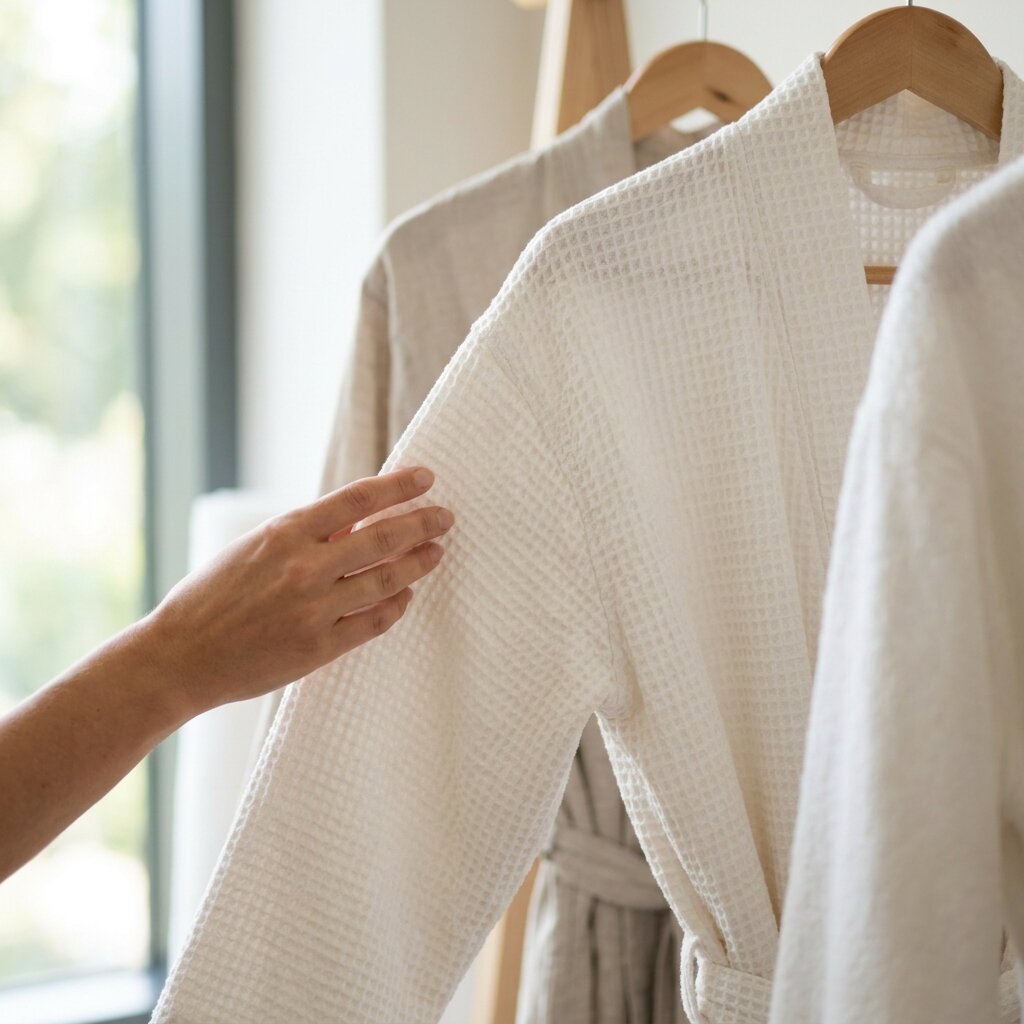
Compare materials and constructions separately: terry for absorbency, velour for a smooth outer feel, and waffle effects for a lighter texture. GSM, yarn and cut also influence how a bathrobe feels and performs.
Compare terry, velour and lightweight constructions according to the spa's requirements. Explore our Textile supplies for spas and wellness centers.
2.1 Cotton terry, velour and waffle fabrics
- Long-staple cotton: Long-staple cotton can be spun into fine, even yarns. For professional bathrobes, consider combed cotton together with yarn quality, terry construction and finishing.
- Absorbent cotton terry: High-quality cotton terry offers good absorbency and a pleasant feel against the skin. Its looped construction holds water. Single and two-ply yarns offer different combinations of hand feel, weight and fullness.
- Microfiber: Known for its extreme lightness, speed of drying and resistance. Microfiber is an excellent choice for bathrobes that need to dry quickly and are subjected to frequent washing. Although it does not offer the same “thickness” feeling as cotton, its efficiency is undeniable.
- Bamboo: Textiles marketed as bamboo are often viscose derived from bamboo cellulose. They can offer a soft, smooth feel; assess composition, construction and care requirements.
2.2 Choosing fabric weight (GSM)
The weight, expressed in grams per square meter (GSM - Grams per square meter), indicates the weight of the fabric. It is not just a measure of density, but a key parameter to understand the quality, absorbency and longevity of a bathrobe:
- 350-450gsm: Lighter bathrobes for warm environments and frequent changes. Terry and waffle-effect constructions are useful options for spa operations.
- 450-550gsm: A versatile range for many spa bathrobes, balancing fabric volume, comfort and laundry requirements. The preferred weight depends on the construction.
- Over 550gsm: Fuller terry bathrobes with a plush feel. Their higher fabric weight can increase laundry loads and drying time.
Choose fabric weight according to desired comfort, operating costs and wellness centre requirements. In addition to classic terry, velour offers a sheared outer surface; our waffle effect is woven directly into terry on the loom, using a construction designed to limit shrinkage compared with conventional waffle fabrics. Compare sample hand feel and garment fit before defining specifications.
3. Styles, maintenance and customisation
Alongside fabric and GSM, consider the cut, seam construction, laundry requirements and customisation options.
3.1 Spa bathrobe styles
Bathrobes are available in different configurations, each with its pros and cons:
- Kimono model: Elegant and minimalist, without hood, usually with a straight cut and a belt. It is lightweight and fits well with a modern, clean aesthetic. Ideal for environments that focus on lightness and freedom of movement.
- Hooded model: Offers extra comfort and increased absorption capacity, useful for drying hair. It is perceived as more enveloping and functional, especially in cooler climates or after specific treatments.
- Shawl collar model: It gives a luxurious and refinement image. The wide and soft neck adds warmth and comfort, recalling the elegance of high-end hotel bathrobes.
The choice of style can also be influenced by seasonality or the specificity of the services offered. For example, for warmer relaxation areas, a kimono might be more popular, while for the post-pool a hood offers more practicality.
3.2 Professional laundering and durability
Bathrobes in hotels and wellness centres undergo frequent washing and hygienic treatment. Textile selection should take account of washing frequency and laundry requirements. The main parameters to evaluate are:
- Color fastness: For coloured garments, select high-colourfastness dyes such as Indanthrene according to the intended use and laundry programmes.
- Dimensional Stability: Assess dimensional stability and garment fit after the intended washing cycles.
- Tensile strength: The seams and texture of the fabric must be sturdy to withstand the stresses of industrial washing machines.
- Easy maintenance: Fabrics must be easy to wash and dry, minimizing the time and costs of managing the laundry.
3.3 Customised spa bathrobes
Customising bathrobes with the wellness centre logo or emblem reinforces brand identity. Embroidery, jacquard or Lancé, depending on the style and fabric construction, also add an exclusive touch. Personalised bathrobes communicate the property's distinctive style and contribute to a memorable guest experience.
Why choose ZA&BEL professional terry textiles
For over fifty years ZA&BEL has supplied professional textiles. Our Italian manufacturing in Busto Arsizio dates back to 1969 and combines textile craftsmanship with innovation. We develop combed cotton terry using single or two-ply yarns, selecting GSM, constructions and finishes according to desired comfort and operational requirements.
Our in-house production allows bespoke dimensions, sizes, styles, colours and customisation for professional use. We supply luxury five-star hotels, resorts, wellness centres and independent family-run properties, including smaller quantities where feasible. We offer customisation to integrate your logo and visual identity. With coordinated logistics and customer support, ZA&BEL helps spas select textiles that match their service standards.
Coordinate spa bathrobes, towels and bath mats to create a distinctive and comfortable guest experience.
Choose ZA&BEL's Italian-made professional bathrobes, developed according to your project, frequent laundering and desired comfort. Explore the complete range of solutions for your spa and discuss your project with an experienced textile partner.
Explore the ZA&BEL spa textile collection