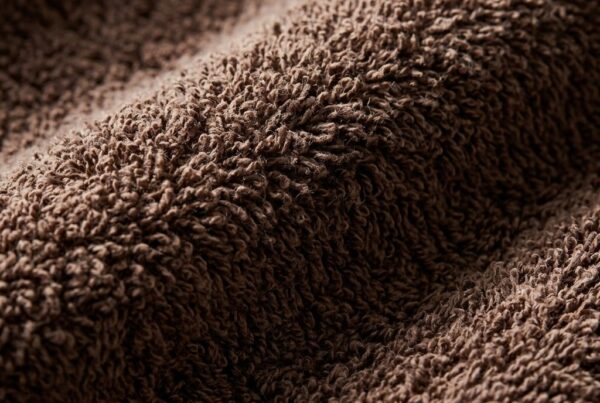

Recognising quality hotel towels means examining the fabric closely and assessing its handle, absorbency, sewing and behaviour in use. Comfort depends on more than weight: cotton selection, pile construction and finishing all contribute to the result. This guide helps compare different terry constructions for guestrooms, suites and wellness areas.
Table of contents
1. GSM and terry quality
Fabric weight, expressed in grams per square metre (GSM), indicates the mass of fabric per unit area. It is not a direct measure of loop density, softness or absorbency. Recognising quality towels also requires considering the terry construction, yarn and finish.
Up to 400 GSM
Lightweight constructions to consider when a less bulky article is desired, for example for specific services or small sizes.
450–550 g/m²
A versatile reference range for guestroom, gym and pool towels, depending on the required construction.
600 GSM and above
Fuller-bodied options for bath sheets and suites, also considering weight and laundry operations.
For a practical comparison, a 100 × 180 cm towel at 450 GSM corresponds to approximately 810 grams of fabric, while at 600 GSM it corresponds to about 1,080 grams. Nominal weight helps assess differences between two products of the same dimensions.
How a professional towel is made
2. Combed cotton, single and two-ply yarns
Combed cotton is particularly suitable for professional terry: combing selects fibres and improves yarn uniformity. Fibre length and combing are distinct characteristics. Single and two-ply yarns can offer different handles even at the same fabric weight. Choose by examining actual samples and assessing the results after washing.
For bath mats, consider 800 or 900 GSM constructions in sizes such as 50 × 70 and 60 × 90 cm. These items serve a different purpose from bath sheets.
3. Assessing towels after laundering
Sewing quality can be assessed through hems, selvedges and stitching uniformity. For professional supplies, examine the fabric surface before and after the intended care procedures, checking loop structure, handle, dimensions and hem appearance. Durability depends on construction and conditions of use. Applicable OEKO-TEX STANDARD 100 documentation concerns tested harmful substances, while laundering resistance is assessed separately.
4. Why hotels often choose white towels
White linen coordinates with many interior styles and makes surface marks easily visible. It is practical for a common linen range across room categories. Laundry procedures should suit the articles' characteristics. For whites we offer Ultra White, while for coloured items manufactured in-house we use exclusively Indanthrene dyes selected for colour fastness. A dedicated shade or woven border can distinguish pool linen from guestroom linen.
5. Sizing linen stock: the three-par rule
An initial stock planning reference is three sets, distributed between guestrooms, laundry and reserve storage. Actual quantities depend on replacement frequency, laundry turnaround and occupancy peaks. For example, forty double rooms with two bath sheets each require eighty sheets for a full change. Three sets correspond to 240 sheets; housekeeping should assess whether additional stock is needed for its own operations.
| Set in guestroom | Set in laundry | Reserve set |
|---|---|---|
| Available for guests | In the washing and drying cycle | Available for replenishment and peak demand |
6. Tessitura ZA&BEL: quality and bespoke manufacturing
Since 1969 we have manufactured Made in Italy terry at our weaving mill in Busto Arsizio for luxury five-star hotels, resorts, boutique hotels and independent family-run properties. We produce towels in single- and two-ply combed cotton with customisable fabric weights, dimensions, colours and borders. Embroidery, jacquard and Lancé coordinate logos with the interior design: Lancé creates a woven motif resembling embroidery with a smooth reverse. Smaller quantities and complementary import/export supplies with separately identified origins can also be considered.
Share your hotel linen requirements so that we can assess terry samples, fabric weights and customisation according to your project.
Request advice for your hotel