
Hotel terry cloth is the fabric used to manufacture towels, bath sheets, bathrobes and bath mats. Construction varies according to department: guestrooms, suites and pool areas have different requirements. A professional supply specification should consider yarn, ground fabric, loops, GSM, finishing and sewing. This guide explains how to combine these characteristics to develop a textile collection suited to hotel operations.
Table of contents
1. Professional terry construction
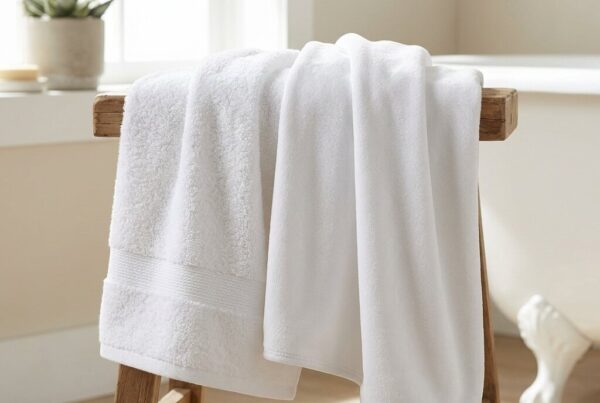
Woven terry comprises a ground warp, pile warp and weft. The ground forms the supporting structure; loops create the characteristic towel surface. Loop height and density are distinct parameters: fabrics of equal weight may have different fullness, consistency and handle. Yarn count and thread arrangement also contribute to the result. Combed cotton is a useful basis for professional production because of its yarn regularity. Single or two-ply yarns can be selected; the latter are formed by twisting two yarns together. Neither is necessarily preferable for every application: compare the overall construction and intended use. Samples allow inspection of the ground and loops, alongside selvedge and hem uniformity.
How a professional towel is made
2. Terry for guestrooms and suites
For guestrooms, 450–550 GSM terry offers a versatile reference range, considering comfort and laundry bulk. For suites, consider 600 or 650 GSM, a soft-touch finish and details matching the bathroom. A 100 × 180 cm bath sheet at 450 GSM has a nominal fabric mass of 810 grams; at 600 GSM it is 1,080 grams. The nominal difference of 270 grams per towel helps compare overall laundry loads. Finished weight also varies with borders and sewing. Different sizes need not have identical GSM: small towels, bath sheets and mats can have distinct constructions. For mats, consider 800 or 900 GSM according to the desired result.
3. Terry for spas, pools and gyms
Pool towels should be assessed according to lounger dimensions, handling and change frequency. A 100 × 180 cm towel in single-yarn combed cotton at 450 GSM is one construction to consider. For gyms, a 50 × 100 cm towel of similar weight can be practical. Treatment-room towels should match table dimensions and service presentation. A velour surface, made by shearing loops on one side, can enhance appearance while retaining loops on the reverse. For coloured articles manufactured in-house we exclusively use Indanthrene dyes selected for colour fastness to light, chlorine and frequent laundering. Dedicated motifs or colours also help staff distinguish departmental linen.
Professional towels for spas and pools
4. Finishing and woven customisation
For whites we offer Ultra White; soft-touch finishing can enhance the handle of terry. Woven borders, embroidery, jacquard and Lancé provide a shared visual language across coordinated collections. Lancé creates a woven motif resembling embroidery with a smooth reverse. Logo placement and size should reflect available surface and folding. Our waffle effect is woven directly into terry with a construction designed to limit shrinkage compared with conventional waffle fabric. Pantone references help define colours, and samples allow comparison across surfaces. Customisation can be adapted to each size without imposing identical construction on every item.
5. Defining and comparing specifications
To compare proposals, prepare an item specification recording intended department, dimensions, composition, yarn count where available, GSM, loop construction, colour, finish, borders and sewing. Compare equal-sized samples for handle, absorbency and presentation. Observe performance after a representative care cycle. OEKO-TEX STANDARD 100 documentation concerns testing for harmful substances; durability and laundering resistance are assessed separately. For replenishment, link the approved sample specification to its item code so requirements remain identifiable. Cost per use considers allocated purchase cost, laundering and actual service life. Involve housekeeping and laundry staff in selecting constructions, particularly when supplies cover departments with different service procedures.
6. ZA&BEL: Made in Italy terry development
Since 1969 we have manufactured Made in Italy terry at our weaving mill in Busto Arsizio for luxury five-star hotels, resorts, boutique hotels and independent family-run properties. Direct manufacturing allows combed cotton articles to be developed with project-specific sizes, GSM, colours, yarns and decorative techniques. To prepare a proposal, share an item list by department with quantities and required characteristics. We can consider representative samples, smaller quantities, stock items and complementary import/export supplies with separately identified origins. Direct discussion with the mill helps define collection specifications and plan subsequent production. This approach combines the property’s visual identity with each department’s operational requirements.
Share your departmental requirements to discuss a bespoke professional terry proposal.
Request hotel terry samples